
Table of Contents
- mAh Capacity Explained: What Power Bank Size Do You Need?
- USB-C Power Delivery Explained for Faster Charging
- How to Maintain Power Bank Battery Health
- Frequently Asked Questions
Last Updated: September 30, 2026
mAh Capacity Explained: What Power Bank Size Do You Need?
A power bank is a portable battery pack that recharges a phone, tablet or earbuds when no mains supply is nearby. Capacity is measured in milliampere-hours (mAh), but voltage and conversion efficiency decide how much stored energy reaches your device, so expect to recover 60% to 70% of the printed figure.
As a working rule:
- 5,000 mAh: one full phone charge, pocket-sized
- 10,000 mAh: two to three charges, the sensible everyday size
- 20,000 mAh: four to five charges, better for travel or two devices
USB-C Power Delivery Explained for Faster Charging
USB-C Power Delivery lets a power bank and a device negotiate the right wattage instead of pushing a fixed current, so the same cable can top up a phone slowly and a laptop quickly (USB Charger (USB Power Delivery)). Wattage is the number to check, not the port shape: 20 W charges most phones at a respectable pace, while 45 W or above suits tablets and smaller laptops.
- Input port: how the power bank recharges, often the slowest link
- Output port: what feeds your device, where wattage matters most
- Passthrough charging: using the pack while it charges, which runs warmer and slower
The cable carries a rating too, and a 100 W cable with the wrong internal wiring caps your charging speed no matter how capable the power bank is.
How to Maintain Power Bank Battery Health
Lithium-ion cells age whether you use them or not, and charging cycles are finite, so keeping a pack between roughly 20% and 80% charge slows capacity loss.
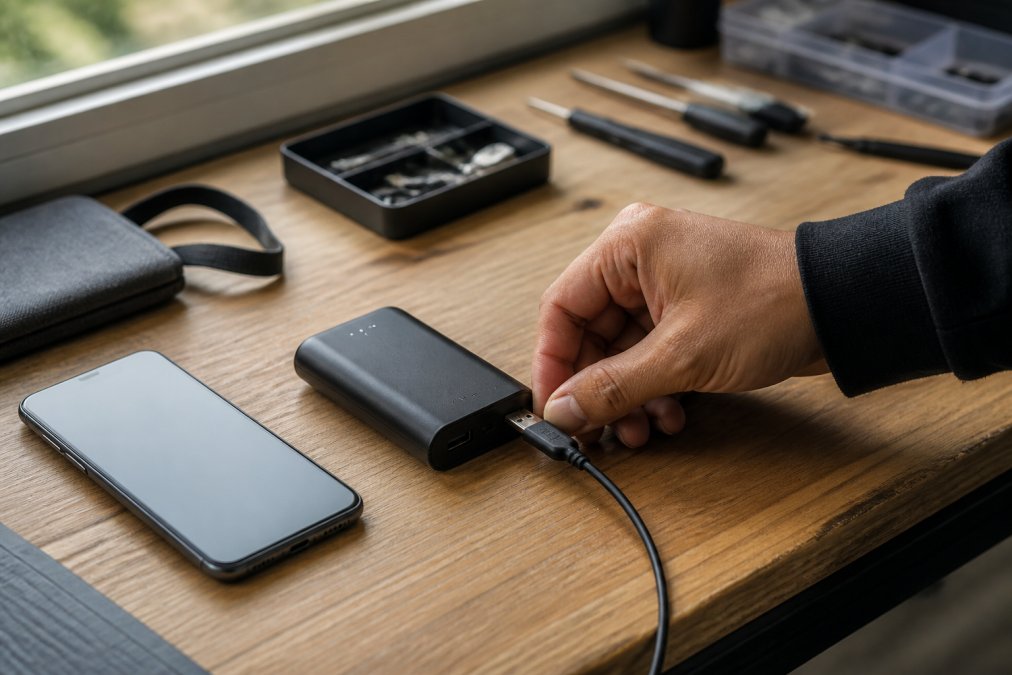
Heat does more damage than any charging habit, and leaving a pack on a sunny dashboard or under a pillow while it charges pushes internal temperature up. Smart charging features now taper the current as the pack fills; if you want a pack that fits a pocket rather than a bag, the Charging Bracelet at £24.99 weighs 54 g and has rapid charging built in.

| Symptom | Likely Cause | What to Do |
|---|---|---|
| Charges fewer times than when new | Normal capacity loss | Replace after 2-3 years of daily use |
| Gets hot while charging | Poor ventilation or a failing cell | Stop using it and recycle it |
| Recharges very slowly | Weak input port or cable | Try a higher-wattage charger and cable |
| Percentage jumps erratically | LED indicator or cell fault | Treat the reading as unreliable |
Frequently Asked Questions
How do I know which power bank to buy for my phone?
Match capacity to how long you are away from a plug. A 10,000mAh power bank gives roughly two full charges for most phones, which suits a day out. A 20,000mAh model covers a weekend or several devices. Check the output wattage too: a USB-C power delivery port at 20W or above will fast charge most modern handsets, while older USB-A ports charge more slowly.
Which is better, a 10,000mAh or a 20,000mAh power bank?
Neither is better in every case. A 10,000mAh unit is lighter and easier to slip into a pocket or bag, so it suits daily commutes and short trips. A 20,000mAh battery pack holds more charging cycles and can top up a phone, tablet and earbuds, but it weighs more and takes longer to recharge itself. Pick based on how many devices you carry and how often you charge.
Should I charge a new power bank to 100% before first use?
No. Modern lithium-ion cells do not need a long first charge. Charge it fully once so you start with a known capacity, then keep it between roughly 20% and 80% for everyday use. Storing a power bank at 100% for weeks, or letting it sit completely flat, both put stress on the battery and reduce its lifespan over time.
A power bank that dies early, runs hot, or never quite delivers the charges it promises is a frustrating thing to carry around. Phone and electronics accessories stocks compact, efficient designs built for everyday use, backed by free shipping, free returns, a 30-day return policy and secure payments. Order now and get a pack you can rely on.


