
Table of Contents
- Why GaN Wall Adapters Cost More Than Silicon
- What Gallium Nitride Actually Changes
- Where the Production Cost Goes
- The Real Benefits of Gallium Nitride Chargers
- Efficiency, Heat and the Running Cost Question
- How to Choose the Right USB-C Charger
- Durability and Long-Term Value Versus Silicon
- Best Practices for Phone Battery Longevity
- Common Mistakes When Buying GaN Adapters
- Conclusion
- Frequently Asked Questions
Last Updated: October 4, 2026
Why GaN Wall Adapters Cost More Than Silicon
If you have compared a GaN wall adapter with a standard charger, you have seen the gap. The GaN unit costs more, and it is often smaller. That raises a fair question: are GaN wall adapters worth the extra cost, or are you paying for a marketing label?
This guide breaks down where the money actually goes.
The short answer: the premium buys real engineering. Gallium nitride is a semiconductor material that handles power conversion with less wasted energy than silicon. That means less heat, smaller parts, and often a longer working life.
But not every buyer needs the same thing. A person charging one phone overnight has different needs from someone running a laptop, tablet, and phone from a single plug. Below, we explain when the extra spend pays off and when a simpler charger is the smarter buy.
What Gallium Nitride Actually Changes
Gallium nitride (GaN) is a semiconductor material that switches electrical current far faster than silicon, so a charger can convert power with less heat and in a smaller body.
That single property drives everything else. Faster switching means smaller internal parts. Smaller parts mean a smaller case. Less heat means components run cooler, which usually means they last longer.
The trade-off is production cost. GaN wafers and the control chips that manage them cost more to make than the silicon equivalents. That cost lands on the shelf price.
So the higher price is not decoration. It reflects a different material and a different manufacturing process.
Where the Production Cost Goes
Most of the premium sits in three places:
- The GaN components themselves. The power chips cost more than silicon ones.
- The control circuitry. Fast switching needs careful voltage regulation to stay stable.
- Testing and safety certification. Compact, high-power units face tighter checks on heat and insulation.
Cheaper GaN adapters cut corners on the last two. That is where safety problems start.
The Real Benefits of Gallium Nitride Chargers
The everyday gains show up fast. A GaN unit is smaller, lighter, and easier to carry. It also runs cooler, so it does not cook your desk or your bag.
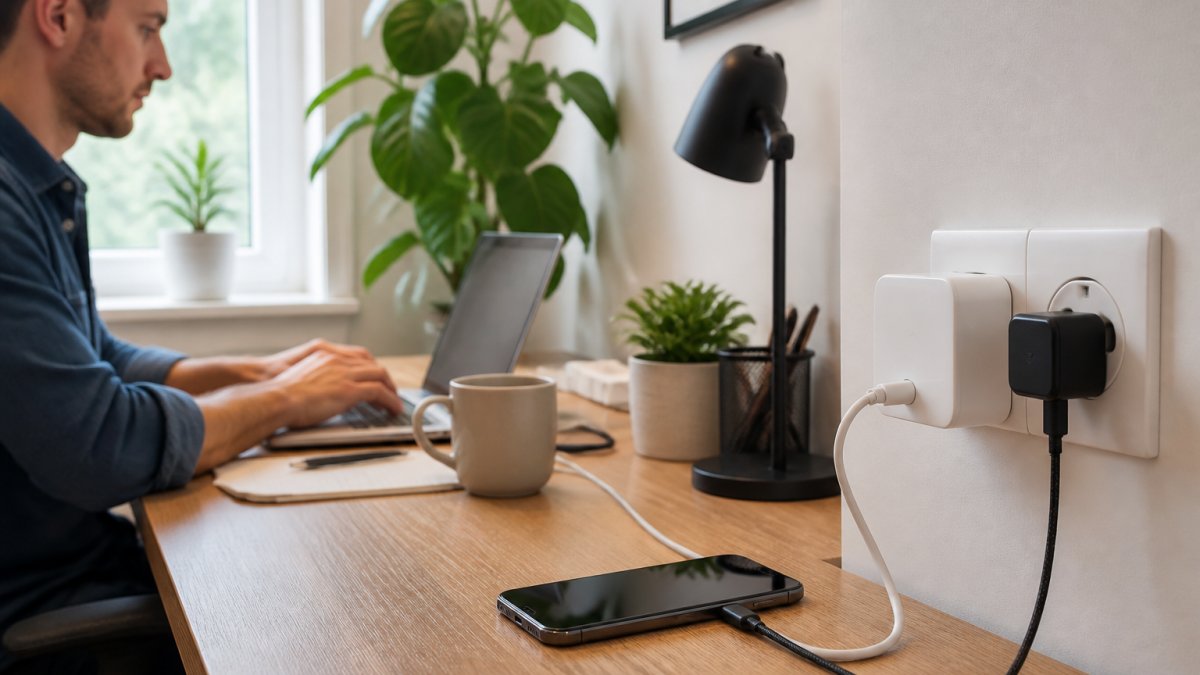
Here is what the benefits of gallium nitride chargers come down to in practice:
- Size and portability. A GaN adapter can be half the size of an older charger with the same wattage.
- Cooler running. Less heat means less strain on the components inside.
- Multi-port charging. One compact unit can power a phone, tablet, and laptop together.
- Better efficiency. More of the power from the wall reaches your device instead of leaking away as heat.
For anyone who travels or works from a small desk, that combination is hard to beat.
Efficiency, Heat and the Running Cost Question
Efficiency is where the money argument gets interesting, and it is also where most guides wave their hands. So let us be precise about what actually happens.
A charger converts alternating current from the wall into the low-voltage direct current your device needs. No conversion is lossless. The energy that is not delivered to your device leaves the charger as heat.
A well-made GaN adapter typically converts a higher share of drawn power into usable output than a basic silicon unit of the same wattage, which means less of what you pay for is shed as warmth.
The practical difference is smaller than marketing suggests, and honest about it: for a single phone drawing 20W overnight, the wasted energy is a trickle. Over a year it is a rounding error on a household energy bill.
Where the running-cost argument actually holds is at higher sustained loads:
- Laptops and docks. A 96W laptop charger running several hours a day draws far more than a phone, so the same efficiency edge moves more energy.
- Multi-device households. One adapter serving a phone, tablet, and laptop replaces several chargers, each of which had its own idle and conversion losses.
- Always-on setups. A charger left plugged in with no device attached still draws a small standby current. Fewer chargers plugged in means fewer standby draws.
So the honest framing is this: efficiency is a real but secondary reason to buy GaN. It is a tiebreaker, not the headline.
The bigger running-cost saving is device longevity, and this is where the maths gets more interesting than the electricity bill. Heat is the primary accelerant of lithium-ion battery degradation.
For a single phone charged slowly overnight, the difference is negligible and a basic charger is a rational choice. For a household running several devices every day, the efficiency edge compounds with the thermal benefit, and that combination is where the premium starts to earn its keep.
How to Choose the Right USB-C Charger
Choosing the right USB-C charger comes down to three things: wattage, ports, and Power Delivery support. Match those to your devices and you are most of the way there.
Wattage, Ports and Power Delivery
Wattage is how much power the charger can supply. A phone needs less than a laptop. Check your device's recommended wattage before you buy.
Ports decide how many devices you can charge at once. A multi-port unit shares its total wattage, so a single high-wattage port matters if you charge a laptop.
Power Delivery (PD) is the standard that lets a charger and device agree on the right power (USB Charger (USB Power Delivery)). Look for PD and PPS support for fast charging on modern phones.
| Your main device | Wattage to look for | Ports to consider | Must-have feature |
|---|---|---|---|
| Phone only | 20-30W | Single | Power Delivery |
| Phone and tablet | 45-65W | Two | PD plus PPS |
| Laptop and phone | 65-100W | Two or more | High-wattage PD port |
| Full desk setup | 100W+ | Three or more | Shared power management |
Durability and Long-Term Value Versus Silicon
Durability is the angle most guides skip, and it is the one that decides whether the premium actually pays off. So let us look at what fails inside a charger and why.
The components most likely to end a charger's life are the electrolytic capacitors. These store and smooth energy, and they are sensitive to heat.
Because GaN switches faster and more efficiently, it generates less heat for the same output. Less heat means the capacitors and control chips run cooler, and cooler components degrade more slowly. That is not marketing, it is the direct consequence of the material's switching behaviour.
But here is the catch that cheap GaN units expose: the material helps, but the build quality decides. A budget GaN adapter with poor thermal design, undersized capacitors, or no heat-spreading can run hotter than a well-made silicon charger and fail sooner.
What separates a charger that lasts three years from one that lasts eighteen months:
- Capacitor quality. Reputable brands use higher-temperature-rated capacitors. This is rarely advertised and is the single biggest lifespan factor.
- Thermal design. Internal heat spreading and ventilation matter more than the headline efficiency figure.
- Power headroom. A 100W charger run at 65W stays cooler than a 65W charger run at its limit. Buying slightly above your needs extends life.
- Build and certification. Proper safety testing signals a manufacturer that did not cut corners elsewhere either.
So the long-term value calculation looks like this: a well-built GaN adapter should outlast several budget chargers, and each budget charger you do not have to replace is money not spent.
Is It Worth It for Your Device? A Decision Framework
The premium makes sense for different buyers for different reasons. Here is how to place yourself:
| Your situation | Does the premium pay off? | Why |
|---|---|---|
| One phone, slow overnight charging | Rarely | A basic charger meets the need; efficiency and thermal gains are marginal at low load |
| Phone plus tablet, daily | Often | Multi-port convenience plus cooler running; replaces two chargers |
| Laptop plus phone, desk setup | Usually | High sustained load makes efficiency and thermal benefits meaningful; one unit replaces several |
| Travel frequently | Almost always | Size and weight savings are the dominant benefit, independent of cost |
| Household with several devices | Usually | Fewer chargers, less standby draw, less heat stress across all devices |
The pattern is consistent: the more power you move and the more devices you serve, the more the premium is justified. At the low end, a single phone charged slowly, a basic charger is the smarter buy, and no amount of GaN branding changes that.
Best Practices for Phone Battery Longevity
Best practices for phone battery longevity are simple, and they work with any charger:
- Avoid extreme heat. Do not charge under a pillow or in direct sun.
- Keep charge between 20% and 80%. Deep drains and full charges stress the battery.
- Use a quality charger. Stable voltage regulation protects the battery over time.
- Skip overnight fast charging when you do not need the speed.
- Unplug when full. Leaving a device at 100% for hours adds wear.
A GaN charger helps here because it runs cooler and holds voltage steady. That is device-specific ROI: the charger protects the battery you already paid for.
Common Mistakes When Buying GaN Adapters
The biggest mistake is buying on wattage alone. A high number means nothing if the charger lacks Power Delivery or PPS support for your phone.
Other common slips:
- Ignoring port sharing. Two ports often split the total wattage.
- Trusting a very low price. Real GaN costs money to make.
- Skipping safety marks. Look for recognised safety standards on the label.
- Buying for one device only. A slightly higher wattage covers future upgrades.
Conclusion
The honest answer is that it depends on how you charge. For one phone overnight, a basic charger is fine. For a desk or a household running several devices, a GaN adapter earns its keep through cooler running, smaller size, and steadier power.
At Phone and electronics accessories, we focus on compact, efficient designs and quality products that exceed expectations. Every order comes with free shipping, free returns, and a 30 day return policy, backed by 100% secure payments.
Order now and get a charger built to protect the devices you rely on every day.
Frequently Asked Questions
What are the main advantages of GaN chargers over silicon?
GaN adapters convert power more efficiently, so less energy is lost as heat. That means they run cooler and can be built much smaller than silicon chargers of the same wattage. They also support modern fast-charging protocols like USB Power Delivery and PPS, so a single compact unit can charge a phone, tablet and laptop. For anyone carrying a bag of devices, the size and heat advantages are the ones you notice daily.
Do GaN chargers charge devices faster than standard chargers?
Charging speed depends on the wattage and the protocol your device supports, not on GaN alone. A 65W GaN adapter with Power Delivery will charge a compatible laptop far faster than a basic 18W silicon charger. Paired with a device that only accepts 20W, the difference is minimal. Match the adapter's output and supported fast-charging protocol to your device for the best result.
Do GaN chargers consume less electricity?
GaN adapters waste less energy as heat during power conversion, so they draw slightly less from the mains for the same output. The saving per charge is small, but it adds up across several devices over a year. The bigger practical gain is that cooler running means less strain on the adapter's internal components, which supports longer service life.
Is it worth replacing my old chargers with GaN versions?
Replace them if you want one compact adapter for multiple devices, if your current charger runs hot, or if you need faster charging for a laptop. If your existing charger is efficient, cool and meets your device's wattage, there is no urgent reason to swap. A GaN wall adapter makes most sense when you are consolidating chargers or travelling with several devices.


