
Table of Contents
- Why Electronic Accessories Make or Break a Trip
- Choosing the Right Travel Phone Charger
- Portable Power Bank for Travel: Capacity, Rules, and Safety
- Travel Headphones: Sound, Comfort, and Long-Haul Performance
- Charging Cables for Travel: Durability and Cable Management
- Protecting Your Devices: Cases, Screens, and Security
- Smart Extras That Earn Their Place in Your Bag
- Conclusion: Pack Smart, Travel Ready
- Frequently Asked Questions
Last Updated: October 7, 2026
Why Electronic Accessories Make or Break a Trip
The right essential electronic accessories for modern travelers turn a stressful journey into a smooth one. This guide from Phone and electronics accessories covers the kit that keeps your phone alive, your data private, and your bag light.
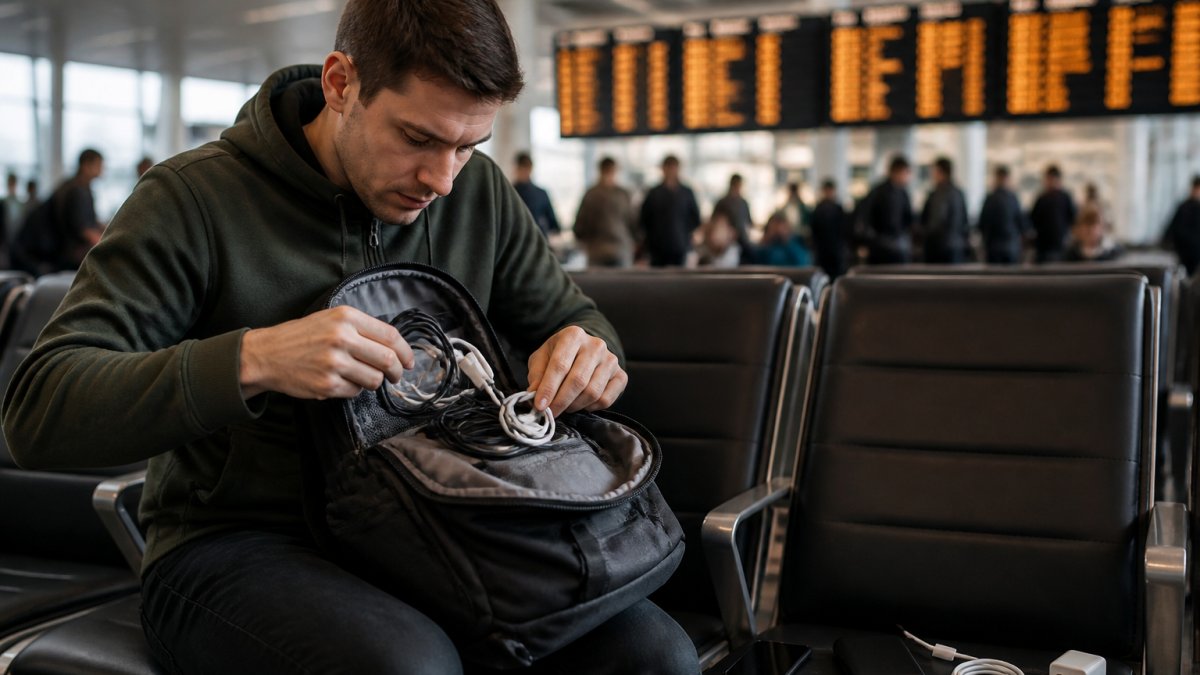
Travel essentials have changed. Most of us now carry a phone, a tablet, headphones and a watch, and every one of them needs power. Pack badly and you spend the trip hunting for a free plug socket.
Here is what most packing lists get wrong. They tell you to bring more. We would tell you to bring fewer, better items that do more than one job.
Choosing the Right Travel Phone Charger
A travel phone charger should be compact, fast, and simple to pack. The best options replace three separate items with one.
Start with what you actually need.
Our Charging Bracelet is a good example of doing more with less.

For a bedside setup, the Charger Lamp doubles as a light source, an alarm and a 15W fast charger.
Charging Bracelet: Wearable Power for Light Packing
The Charging Bracelet suits anyone travelling with hand luggage only. There is no cable to untangle and nothing loose in your bag. It is the sort of item that quietly solves a problem you did not know you had.
Portable Power Bank for Travel: Capacity, Rules, and Safety
A portable power bank for travel is the single most useful item in your kit. Choose one that matches your longest day away from a power source, not the biggest number on the shelf.
Work Out Watt-Hours Before You Buy
Capacity is quoted in milliamp-hours (mAh) on the box, but aviation rules are written in watt-hours (Wh). The conversion is simple:
Watt-hours = (milliamp-hours ÷ 1,000) × voltage
Most power banks are rated at 3.7V nominal, so a 10,000mAh bank is roughly 37Wh and a 20,000mAh bank is roughly 74Wh. That matters because the common airline threshold sits at 100Wh: banks under it are usually fine in hand luggage, banks between 100Wh and 160Wh typically need airline approval in advance, and anything above 160Wh is normally refused. For the rules that apply to carrying batteries, see the Civil Aviation Authority guidance on dangerous goods.
Size the Bank to Your Trip, Not the Spec Sheet
A useful rule of thumb: a modern phone battery holds roughly 4,000-5,000mAh, and a power bank delivers about 60-70% of its stated capacity after conversion losses. So:
- 5,000-10,000mAh, one to two phone charges. Enough for a day of sightseeing or a short-haul flight.
- 10,000-20,000mAh, two to four phone charges, or a phone plus a tablet. The sweet spot for most week-long trips.
- 20,000mAh and up, multiple devices over several days, but heavier and closer to the 100Wh line. Only worth it if you are off-grid for long stretches.
Weight scales with capacity. A 10,000mAh bank typically weighs 180-220g; a 20,000mAh bank usually lands between 350-450g. If you are travelling with hand luggage only, that difference is real.
Pass-Through Charging and Port Choice
Two features separate a good bank from a frustrating one:
- Pass-through charging lets the bank charge itself and your phone at the same time from one wall outlet. Useful in a hotel room with limited outlets, though it runs warmer and slightly slower.
- USB-C Power Delivery (PD) is now the standard for fast charging phones, tablets and many laptops. Look for at least one USB-C PD port rated 20W or higher, plus a USB-A port for older cables. A bank with two outputs and one input is the practical minimum.
Check that the bank's output wattage matches your device. A 20W PD port will fast-charge most phones; a laptop needs 45W or more, which pushes you into larger, heavier banks.
Safety and Compliance Habits
- Carry power banks in hand luggage, never in a checked bag
- Keep the original casing intact so the capacity label stays readable
- Never charge a power bank under a pillow or on a soft surface
- Store it away from keys and loose metal
- Avoid fully draining it; partial charges extend cell life
Airline Regulations and Battery Limits
Battery limits differ between carriers and can be updated at short notice. Check your airline's own page before every trip, and confirm the watt-hour rating is printed clearly on the device. If your bank sits near a threshold, carry the manufacturer's spec sheet or a screenshot of the product page, it speeds up any query at the security desk.
Travel Headphones: Sound, Comfort, and Long-Haul Performance
Travel headphones need to do two things well: block out cabin noise and stay comfortable for hours. Everything else is a bonus.
Comfort matters more than spec sheets on a long flight. Look for a light fit, soft ear cushions and a battery that outlasts your journey.
If you would rather not carry full-size headphones, the Conduction Speaker is a compact alternative.

Conduction Speaker: A Compact Alternative for Shared Spaces
Bone conduction works by sending sound through a surface rather than into your ears alone. That makes it useful when you want music in a room without sealing yourself off from everyone in it.
Charging Cables for Travel: Durability and Cable Management
Charging cables for travel fail more often than any other item in your bag. The fix is fewer cables, better made, stored properly.
Braided cables last longer than plain rubber ones because the weave protects the wire inside.
Cable management is the part most people ignore. A small pouch or a cable tie keeps everything separate, stops tangles, and makes security checks quicker.
Protecting Your Devices: Cases, Screens, and Security
Protection is where a good kit separates itself from a cheap one. A cracked screen on day one ruins the trip.
Our Privacy Screen does two jobs at once. It lets you see your display clearly while blocking the view from the person beside you, and it protects the screen from scratches and knocks.

For valuables left in a room, a lock adds a layer of security.
Privacy Screen: Shield Your Data in Public Spaces
A privacy screen is worth carrying if you check email, banking or work documents in public. It costs little, weighs almost nothing, and stops the person next to you reading your screen.
Smart Extras That Earn Their Place in Your Bag
Some accessories sound like gimmicks until you need them. The test is whether an item solves a problem you will actually hit on the road, connectivity, security, or a specific practical task. Here is how to judge the extras, plus the connectivity kit most packing lists overlook.
Connectivity and Offline Access: The Gap Most Lists Miss
Staying connected abroad is where a good kit separates itself. Three options cover almost every trip:
- eSIM, a digital SIM you install before you fly. No shop visit, no physical card, and you can keep your home number active for calls while using local data. Best for short trips and single-country travel. Check your phone supports eSIM and is carrier-unlocked before you buy a plan.
- Travel router, a small device that takes one Wi-Fi or Ethernet connection and shares it across your devices. Useful in hotels that charge per device or limit connections, and for keeping a private network on shared Wi-Fi.
- Portable hotspot, a pocket device with its own data plan. Best for families or small groups sharing one connection, or for remote work where a stable link matters more than cost.
Whichever you choose, download offline maps and any translation, boarding pass or booking apps before you leave. Offline access is the difference between a smooth arrival and a stressful one when signal drops.
The National Cyber Security Centre guidance on protecting devices abroad is worth reading before any trip where you handle work data on public networks.
Infrared Phone Adapter: Control Hotel Devices Instantly
The Infrared Phone Adapter is a plug-and-go gadget that lets you control up to 15 devices from your phone. It works with almost any device that uses IR signals, so hotel televisions, air conditioning units and lights all become controllable from one place. Setup is quick and it costs £14.99. If you have ever hunted for a missing hotel remote, this solves it.
Portable Printer and Fingerprint Lock: Practical Additions
The Portable Printer connects to your phone and prints wherever you are, which suits students, remote workers and anyone who needs a hard copy on the move. It has fast connection times and a durable build. At £74.99 it is the priciest item here, so buy it only if you genuinely print on the road.
The Fingerprint Lock, covered above, pairs well with it for keeping documents and devices secure.
Buying Criteria for Any Travel Extra
Before an item earns space in your bag, run it through four checks:
- Weight, every gram counts if you travel with hand luggage only. Aim for extras under 150g unless they replace something heavier.
- Ports and compatibility, does it work with the cables and standards you already carry (USB-C PD, Bluetooth, IR)?
- Durability, braided, reinforced or hard-shell builds survive being packed and repacked.
- Price versus use, a £15 item you use daily beats a £75 item you use once.
| Accessory | Price | Best For | Why It Earns Its Place |
|---|---|---|---|
| Charging Bracelet | £24.99 | Light packers | Wearable charger, 54g, no cable |
| Privacy Screen | £22.99 | Public Wi-Fi users | Blocks side views, protects screen |
| Infrared Phone Adapter | £14.99 | Hotel stays | Controls up to 15 IR devices |
| Fingerprint Lock | £34.99 | Hostels, shared rooms | Secure entry, no code to forget |
| Conduction Speaker | £39.99 | Shared spaces | Bluetooth sound anywhere |
| Charger Lamp | £59.99 | Hotel rooms | Light, alarm and 15W charger |
| Portable Printer | £74.99 | Remote workers | Prints from your phone |
Conclusion: Pack Smart, Travel Ready
Packing light is a skill, and the right accessories make it easier. The goal is a kit where every item does at least one job well and nothing sits unused.
At Phone and electronics accessories, we stock the practical pieces that solve real travel problems: a wearable charger for light packers, a privacy screen for anyone working in public, and a compact speaker for shared spaces.
Order now and build a travel kit that keeps every device running from departure to arrival.
Frequently Asked Questions
What are the most essential electronic accessories for modern travelers?
The core kit includes a reliable travel phone charger, a portable power bank for travel, durable charging cables, and travel headphones. Add a privacy screen for data protection and a compact case to keep everything organised. For longer trips or business travel, a portable printer and an infrared phone adapter can prove surprisingly useful. Focus on items that are lightweight, durable, and compatible with your devices.
What should I look for in a portable power bank for travel?
Check three things: capacity, portability, and airline compliance. A 10,000mAh to 20,000mAh power bank covers most phones for two to three charges. Confirm the watt-hour rating falls within airline limits for carry-on baggage. Look for fast-charging support and at least two output ports. Weight matters too. A power bank you barely notice in your bag is one you will actually carry every day.
Are wireless headphones useful for long journeys?
Yes, particularly for flights and train travel. Wireless travel headphones eliminate cable tangles, let you move freely, and many models offer noise cancellation that reduces engine drone. Battery life is the key spec. Aim for at least 20 hours so you are not hunting for a charge mid-journey. A compact carrying case protects them from breakage in a packed bag.
How can I keep my phone and other devices organised while travelling?
Use a dedicated tech pouch or travel case with elastic loops for cables and compartments for your power bank, adapter, and headphones. Label or colour-code cables so you grab the right one first time. Keep your most-used items, phone, charger, and cable, in an easy-access pocket. A compact setup reduces breakage and speeds up security checks.


